Newsletter – Volume 1
February 7, 2009
Newsletter
Vol. 1, Fall 2004
Message from Dee Dee Williams, Founder of Three Little Kittens
To all:
Thank you for your help and support in getting our website and newsletter started because, left to my own devices, I might never get out of the kitten nursery long enough to do anything else.
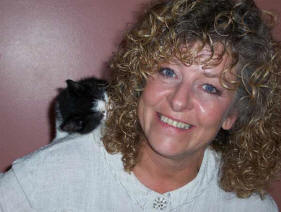 All my life I have been first and foremost a care giver – both by inclination and by profession. Over the years, I have worked in many different occupations, but several of them involved healthcare. For example, I’ve worked in support positions at the Norristown State Hospital and in the Ear, Nose and Throat Department at the University of Pennsylvania Hospital. I have also worked as a Veterinary Assistant. My most personally painful but also in some ways most gratifying role as a care giver was the year I devoted to being the 24/7 primary caretaker for my father after he was paralyzed as the result of an accident, with his resulting condition identical to that of Christopher Reeves. That year I learned more than I ever thought I could about caring, about patience, and about myself. It also taught me a great deal about the physical and psychological health benefits of home health care over institutional care. In this regard as well as in other ways, Three Little Kittens is closely linked to the memory of my father.
My desire to help those in need of care always included the animal world because I believe animals deserve to be on this earth as much as people do. For as long as I can remember, animals have fascinated me. When I was three years old, I would crouch down and watch ants, endlessly amazed by their busy work (okay, so they’re actually insects…but so what?). As a teenager I worked to save baby seals, and after that came Save the Whales and numerous other animal causes.
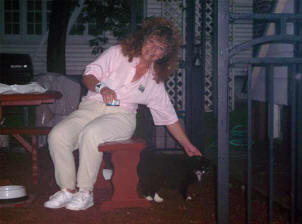 I have owned many cats through the years. Right now I have nine living inside, and seven living outside. All but one of my current indoor cats is from one of the many litters of my outside colony. Amazingly, two of these litters were actually delivered to my doorstep by the matriarch cat, who must have been tired of kittens but still wanted to make sure they would be cared for.
So how did all this start?
Many years ago, I was one of several in my neighborhood in Asbury Park who started feeding the original outside feral cat colony, which used to be much larger than it is now. I found it impossible to turn these cats away when they came to the door seeking food, especially with young kittens trailing behind them. I felt that by feeding them cat food, I at least kept them from rummaging through rancid garbage and gave them a chance to stay healthy.
With an ever-growing colony of feral cats, I realized I had to do more than feed them. Since I had my indoor cats spay/neutered and given shots, why not do the same for the outside ones? With the financial support of my neighbors, I trapped them one by one in a carrier and took each to the SPCA’s low-cost clinic where they were given shots and spayed/neutered. I then brought each one home for convalescence in a kennel set up in my basement, and eventually released them back into my yard.
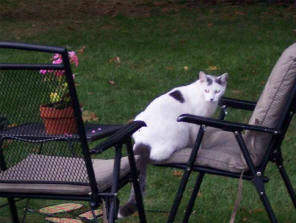 With help from my partner, Brendan, I created a small door that gave them access to the garage. We removed all fertilizers, chemicals, etc, and provided pallets with old carpeting, old outside furniture, and several blankets and sleeping bags for the cats’ use during cold weather. The following spring, we added a canvas gazebo, which keeps the cats, their food, and me dry in rainy times. The picnic table also has a “cat condo” scratching post on it where my one male (Elliot) loves to sleep.
After caring for several very young kitten litters I realized I not only loved what I was doing, but was also very good at it. Any kitten delivered to my care has either remained with me, or been successfully adopted out. Many of the people who adopted kittens from me have stayed in touch and keep me up-to-date on their lives with the kitten I fostered, even sending kitty photos from time to time!
So here I am now, determined to take what I have been doing all these years out of love, and make it my life’s work. I believe that feral kittens fostered at a young age make some of the best and most loving pets. And that by doing what I do, I help the kittens, their prospective owners and the community as well, because I am reducing the feral cat population.
 Through my work with feral cats, I have learned much and met some truly exceptional people who are now helping me to make Three Little Kittens a success. I would like to thank everyone who has helped bring us to where we are today, and to all of you who will join us as we grow.
Please see the How You Can Help section of our website to learn more about our members, our partners and the many ways that you can become part of Three Little Kittens’ mission.
Many thanks and all my love, Dee Dee
Three Little Kittens Organizational News
In this section of our Newsletter, we will keep you up to date on organizational happenings, accomplishments and new initiatives of Three Little Kittens.
Tax Status
Our first and foremost organizational priority right now (beyond kitten care) is attaining our 501C non-profit tax status. The good news is that accountant Robert Owen has agreed to help us. In soliciting member support, we will keep you abreast of the status of this effort and what that means to us and to you.
Facilities Renovation
On another front, the Nursery (where our under aged and untested kittens live), and the “Kids” room (where our “of age” and tested kittens that are ready for adoption live) are under renovation. This has been a real trick, as we also have kittens in both spaces. Most of our current kitten population is accustomed to being transported to my dining room for temporary housing while we work in the room. (This event is a thrill to Dee Dee’s indoor adult population, who are restricted from any kitten space, as they can see through the French door to the kennel holding kittens.) We have also worked at temporarily lowering the current TLK kitten count to enable us to finish this phase. This is difficult, as we would prefer to find homes for the kittens we foster for the SPCA, but we recently asked them to take some back and help us in their adoption, as the tasks at hand were getting overwhelming. All the while, there are cat rescuers waiting for us to finish the nursery renovation who have kittens ready NOW!
The nursery has now been repaired and painted a rose color with new molding. Mini-blinds and curtains with kittens on them will be hung when it is finished. Melome cabinets will be assembled to make our baby boxes and our older kitten kennels. Overall the nursery is rose and white. Sandy Faiola, who operates a handyman business, has lent her talents in repair, painting, carpentry, etc. to Three Little Kittens to help to renovate these spaces. We don’t know what we would do without her!
The kids’ room is being painted blue. A kitten pattern wallpaper border and new Mini blinds should finish it off. A repeat Melome kennel will be added for times that they need to be off the floor (for cleaning) or some need to be introduced to the kids’ playroom before being released to play with the others. (Kind of an adjustment period.) For the most part, this room looks just like home. These kittens can roam free, playing with each other and toys!!
And So Much More
Many other people are pitching in to help us get more organized and to develop and professionalize our communications with the public. Marianne Bays, a management consultant in real life, is poking her nose into all aspects of Three Little Kittens‘ operations and providing advice on organization and management process, helping to keep people focused and on-track in our website and newsletter projects, and is serving as our editor of written materials. Wayne Robinson has lent his considerable talent and experience in information technology to us. He is the primary force behind the establishment and implementation of Three Little Kittens website (www.threelittlekittens.org). Three Little Kittens has also had help from Ken Bittman, a graphic artist with tremendous artistic talent and many years of experience as an Art Editor in print media. Ken created the Three Little Kittens logo that appears as the banner in our website, designed the website page layout and he will also be providing us with cat and kitten artwork to help make the website even better in months to come. Last, but not least, Inna Shames, a marketing consultant in real life, is providing her expertise to us. She is helping us to develop a marketing strategy and plan for Three Little Kittens that will enable us to attract the resources we need to achieve all that we have set out to do.
Partner & Member Profiles
In this section of the Newsletter, we will periodically profile the important people and organizations that work with Three Little Kittens, to provide our readers with more information on who we are and about services that are complementary to those that we offer.
Tiffany Miller
Tiffany Miller is an important member of Three Little Kittens. She came into Dee Dee Williams’ life in late summer of 2003. Dee Dee’s now spayed feral colony matriarch, Poe, had her last litter in May of 2003. When the kittens were barely two weeks old, Poe delivered them to Dee Dee’s backdoor. There were four of them; a spry tiger male (adopted by Tiffany and now known as Emerson), a second male (with a Maine coon cat appearance, who Dee Dee called Teddy Bear), and two females, predominantly white and very fluffy. The first female was adopted by Tiffany’s sister and goes by the name of Gizmo (yes, like in the movie), the second lives with Dee Dee, and her name is Kate (after Katherine Hepburn), but they call her Katie.
It would appear as if destiny brought Tiffany Miller to Dee Dee’s door. They got along famously and quite quickly! Of course, they both acknowledge that they have “kitten head”, and nothing starts good friendship like having something in common. On three occasions through the year Tiffany sent Dee Dee notes from Baby Emerson and a Christmas card. With that kind of a heart, why wouldn’t she be the first person Dee Dee called when she needed help setting up Three Little Kittens?
Tiffany’s response to Dee Dee’s call was excitement; she said she had hoped all along that Dee Dee would decide to do this. And, she has willingly contributed her time and talents to the effort. She has helped in kitten care, investigated Three Little Kittens‘ non-profit status, researched grants that are available to help efforts like ours (Tiffany has grant application writing experience!), found posting sites for our kitten adoption flyer, contacted veterinary hospitals, and done whatever else needed to be done.
A couple of fun things to share about Tiffany: The first time Dee Dee worked on bottle training with her, Tiffany had this to report about the kittens upon Dee Dee’s return from running errands, “When I went to feed them, they all behaved badly, dancing on their hind legs and singing “Rookie”. (But, she did just fine!) Also, whenever Tiffany is working at Three Little Kittens, she always (and we mean always) leaves something behind when she goes home!
Dee Dee wishes she could pay Tiffany to work with her all the time. In the meantime Tiffany has been offered a job and accepted it with, naturally, another helping group, Catholic Charities. AND she says she is still willing to volunteer time to Three Little Kittens. Dee Dee asks: “When did I start having angels brought to me? They’re everywhere in my life these days.”
Three Little Kittens owes much thanks to Tiffany Miller, and we hope you all have a chance to meet her or speak with her. Just like Dee Dee, her first concern and focus is on the kittens. Oh yeah, she calls them “Boobalas”. We Love you Tiffany.
Nancy Barr-Brandon
Three Little Kittens has found an amazing partner in Nancy Barr-Brandon, an extremely dedicated woman who has made a career of trapping, spay/neutering and returning feral cats to their colonies, and who now works in Monmouth County.
Nancy originally got involved in this work years ago when she was living in Seattle, where the number of homeless cats appalled her. She brought her efforts to Monmouth County in 1993. In Asbury Park, she has found a worse situation than in Seattle. Both places have a large population of feral cats. However, there are no government-sponsored shelters in New Jersey as there are in Washington State, and places such as the Jersey Shore Animal Shelter and the SPCA are hard-pressed for space, leaving more cats on the streets.
In Monmouth County, Nancy focuses her trapping, spay/neutering and return work primarily on housing projects and ghetto areas where the needs are both the greatest and the work the most demanding, both physically and emotionally. In cases where stray cats that she has captured are found to be social and loving, Nancy seeks adoptive homes for them. The Monmouth County SPCA currently limits her to bringing them 2 cats per week for adoption; this is all they can accept due to overcrowding. Additionally, though, because many feral cats do not socialize well and are not suited for adoption as pets, as an alternative, Nancy also sets up feeding stations for feral cat colonies and helps to feed them.
Nancy’s not-for-profit organization is called Cat Assistance Network, Inc. Three Little Kittens has experienced her effectiveness first hand. As soon as Three Little Kittens had more kitten nursery space cleared out, Nancy made sure we had kittens to fill it! And they just keep on coming! She is tireless and generous, providing us with advice, loaning equipment, and referring kitten rescuers to us.
In the years that Nancy Barr-Brandon has been doing this, she has rescued an estimated 300 cats a year. A special place in heaven will be waiting someday for this lady!
View our current Three Little Kittens Membership List here.
Wish List
In this section of our newsletter, the things we need that are one-time purchases will be listed. The How You Can Help section of the website will continuously list the supplies that are consumed by us regularly, things for which we need a continuing supply (e.g., food, cleaning supplies, etc.).
Here, though, is our Wish List, for things that we wish we had, currently can’t afford to purchase, but hope someone will be generous enough to provide:
- Something to play music in the nursery – a radio or a CD player.
- A digital camera of our own so we can take pictures of the new kittens we have available for adoption.
- A set of 3 matching decorative crib blankets or quilts for the (newly rose & white painted) nursery.
- A large, multi-platform scratching post for “the kids room”.
Kitten Corner
This section of the Newsletter will report on “Kitten Happenings” at Three Little Kittens, keeping you up to date on kitten rescues, kitten care activities, kitten adoptions and kittens available for adoption.
It’s been busy here the past six weeks. At the very end of August we took in our one week old Cubby and his adoptive two and a half week old sister Karen. (For those of you old enough to remember the original Mouseketeers, Cubby and Karen were the two youngest.) Although Cubby is still a bit small, his sister Karen is ready for adoption. They’ve been a fun addition to the nursery. You can see a picture of Cubby and Karen on the Kitten Rescue page of our website.
More recently, a holding shelter that was scheduled to “put down” a number of kittens asked us to take in a litter. We call them “The Composers”, and they are Mozart, Beethoven, Bach and Chopin. True to their names they are musical ‘purrers’. A lovable bunch, testing negative, they’re ready to go to new homes as well. The shelter is waiting to hear from us about taking another litter.
We have also fostered a “mixed bag” litter for the SPCA. By mixed bag, I mean they came in as individual kittens and were put together to form a “near litter” of friends; kittens that have been in intimate contact with each other almost since birth. After fostering them, we had to return them to the SPCA for adoption, just to save time and space during our renovation. Flopsey Mopsey (the big eyed, black fuzzy, palm-sized kitten featured on the About Us page of this website) has ALREADY been adopted. You go girl!!
Then we rescued a litter of four, right here in Asbury Park. Two were nearly all white kittens, and two were a mix of white and gray tiger. We call them our ‘White Christmas’ litter, and they are Bing, Rosemary, Danny, and Vera. They too are all tested and ready for adoption. They are energetic and very lovable!!
By the way, all of the names we give the kittens are for identification purposes and temporary. We expect our adopting parents to choose any name they want. A few of our kittens that were adopted out have taken their nursery name with them. But that’s entirely up to you.
Update (May 2009): Kitten Corner is now part of our new web site! To view future Kitten Corner stories, click here.
Letters from Members
Dear Dee Dee,
I read a Letter to the Editor in my local paper this week that made me think of you and the wonderful work that you are doing with feral cats. A woman wrote that residents of my town, Montclair, shouldn’t feed feral cats because, she notes, they are a health hazard and feeding them will automatically turn our yards into breeding grounds for disease. She said it’s cruel to leave cats living outside – but offered no insight into an alternative.
I couldn’t help but think of your lovely garden, outdoor cat shelter and feeding area and the happy looking small colony of spayed/neutered cats that you care for there. Not to mention the ones that you and Brendan have adopted and care for inside your home, and the ones you have rescued, fostered and found good homes for.
I know, because of what I’ve seen you do over the years since you moved to Asbury Park, that it is indeed possible to intelligently care for neglected “at risk” cats and kittens. When you first moved to your home, the neighborhood cat population and its needs seemed overwhelming. And, one at a time, I’ve seen you find solutions to help them.
You recognized early that there was medical care needed, in addition to food. I remember how determinedly you wooed the poor cat with the ingrown flea collar, until you could finally capture it safely and take it for medical care. And, one by one, you’ve since captured each adult cat in the colony, had it neutered/spayed, given it a safe place to recuperate and then released it back to its outdoor home.
Your charity and love of cats has sometimes brought you sorrow, too. Some kittens have come to you too tiny or ill to survive – one, famously, dropped by its mother on your doorstep for the care that she was unable to give it in feeble hope that the nice lady inside could help. But so many, fortunately, have prospered under your care and found a good home with you or those that you found to adopt them. And, that, I know, is what keeps you going.
I’m proud of you for what you’re doing! It isn’t easy – but that’s never stopped you before. In the decades that I’ve known you, you’ve rarely chosen the easy way out and you’ve always stepped up to do what you believed needed to be done. I know you have the energy, creativity, knowledge and integrity to do it well.
You have something else, too, that is all too rare in the world today and will serve you well – the ability to connect with other people, veterinarians and animal rescue professionals and ordinary citizens as well, and to motivate them to work with you in “good deed doing”.
With love and admiration, I offer you this letter as a testimonial to who Dee Dee Williams is and why others should support your efforts. I know you’re too modest to tell them yourself, so I hope there is room in your newsletter to print this instead.
— Marianne
(Editor’s note: The writer of this letter, Marianne Bays, wrote it when Three Little Kittens first began developing the concept of a regular newsletter to communicate with the public. The part that she wrote about Dee Dee’s ability to motivate others to help her with this venture was “right on” as, shortly thereafter, she herself got the “I need help” call from Dee Dee and shortly after that found that she’d somehow agreed to become the Newsletter and Website Editor. Did I say the lady was good, or what? )
Ask Dee Dee
In this section of our newsletter, Dee Dee will answer your questions about cat and kitten care.
You can e-mail questions to her at kittensthree@optonline.net, or call 732-988-3024 with your questions.
Question: When should I take my kitten to a Veterinarian for the first time and what treatments and tests will the kitten need?
Answer: Well, there’s really no age too young to have your Vet look at a kitten that has not come from an organization, like an adoption clinic, Three Little Kittens, or the SPCA. If you have adopted from one of these sources, though, they have likely done much of the early work for you and will send you home with that information as well as a recommendation for future needs.
Your Vet will be able to confirm sex, check its general health, and set you up for a schedule of when to do what. Some Vets prefer not to see them before eight weeks; as to do everything at one time is certainly a savings, and some things cannot be done until then, although there are exceptions. So if the kitten is showing no signs of illness, you can wait until then. (Signs of illness would be runny pink eyes, lethargy, scratching at ears or excessive diarrhea). But keep in mind, if you have other cats; be sure to keep the kitten isolated from them until you know for sure that these tests have been done. This is also a good motivation for having your Vet see a new kitten earlier. Treating for worms, or having it tested for disease is important for your household. Protect your other cats.
The following is my best advice about the treatments and tests that your kitten will need. Keep in mind, though, that I am not a veterinarian. I always check with my Vet before moving forward on any advice, and you should too.
A general rule is a fecal (stool) test for parasites should be done as soon as your Vet says they can take the medication for worms. This could be as early as three or four weeks.
The “Combo” test for Feline Aids (FIV) and Feline leukemia is done between five and eight weeks of age, depending mostly on the size of the kitten. Small kittens have very small veins, and drawing the blood is impossible until they are a certain size. My Vet recommends that all kittens be retested down the road, to confirm the initial results. (See the Feature Story in this newsletter for more information on “false positives” in FIV testing.) Although rare, it is possible for a kitten to test negative, then later retest as positive. So, might as well check it to be sure, regardless of what the initial results were.
Their first shots (kitten rabies and distemper) usually begin at eight to ten weeks of age, which is also the average adoption age for young kittens. There will be a series of three shots needed.
At five to six months, most Vets will spay/neuter your kitten (again, this will depend upon the size of the kitten – with small kittens, you will need to wait longer). I believe strongly that it is better for you and your kitten to have them spayed or neutered BEFORE they mature sexually. I’ve found that excessive energy or aggressiveness (even if just playful) subsides some after this, which results in a more peaceful home life for you and higher quality of life for your pets, too.
Three Little Kittens Contact Information:
Phone: 732-988-3024
e-mail: kittensthree@optonline.net
Watch Us Grow…
Thanks to You: Our Members!




 Three Little Kittens | Rescue, Foster Care & Adoption Services | New Jersey
You must be logged in to post a comment.